The LOTL 2.0 Underwriting Playbook: Risk Selection Criteria When the Attacker Is an Algorithm

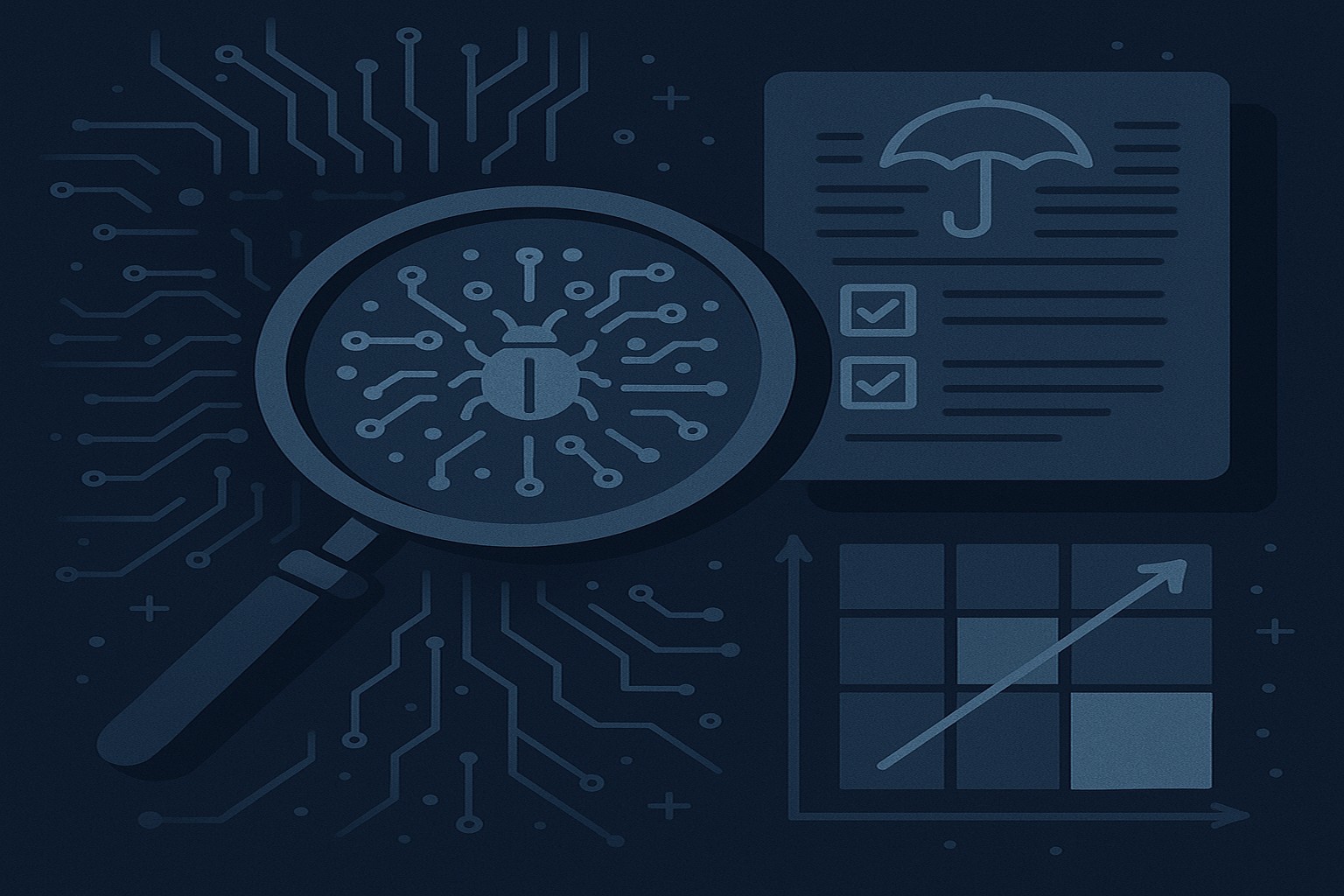
Practical underwriting framework for assessing cyber risk in the era of autonomous LOTL attacks. Includes revised risk scoring matrices, control weight adjustments, and application question updates for underwriters.
In our first analysis of LOTL 2.0, we established that the convergence of autonomous AI agents with living-off-the-land tradecraft is collapsing the cost, skill, and detectability constraints that historically limited sophisticated attacks. Now we turn to the practical question: how should underwriters adjust their risk selection?
This isn’t about rewriting your entire underwriting manual. It’s about rebalancing the weight you assign to existing controls and adding a few new dimensions to your assessment.
The Core Shift: From “What Tools?” to “What Behavior?”
Traditional underwriting questionnaires focus heavily on the presence of specific security tools: Do you have EDR? A SIEM? A firewall? Endpoint protection?
LOTL 2.0 renders many of these questions less useful because the attacker isn’t using tools that these products are designed to detect. The more relevant question becomes: “Can you detect anomalous use of legitimate tools?”
The Control Weight Rebalancing Matrix
| Control Category | Pre-LOTL 2.0 Weight | LOTL 2.0 Weight | Reason |
|---|---|---|---|
| Antivirus / Signature-based EDR | High | Low-Medium | LOLBINs are signed, legitimate binaries |
| Network perimeter controls | High | Medium | Lateral movement uses legitimate protocols |
| Email security / anti-phishing | High | High | Initial access vector remains critical |
| Behavioral analytics (UEBA) | Medium | Very High | Detects anomalous tool usage patterns |
| Identity & Access Management | Medium | Very High | Limits what compromised credentials can do |
| Privileged Access Management | Medium-High | Very High | Constrains lateral movement fundamentally |
| PowerShell / script logging | Low | High | Critical visibility for LOTL detection |
| MFA on all admin accounts | High | Very High | Credential theft + LOTL = unstoppable without MFA |
| Network segmentation | Medium | High | Contains lateral movement even with legitimate tools |
| Incident response retainer | Medium | High | LOTL forensics are more complex and time-consuming |
The total “weight” hasn’t changed — but the distribution has shifted significantly toward identity and behavior controls and away from perimeter and signature controls.
Revised Application Questions
Here are specific questions that should be added to or emphasized in cyber insurance applications for mid-market and enterprise risks:
Identity and Access Controls
Tier 1 — Must Ask:
- Are all privileged accounts required to use MFA? (Not just “admin accounts” — specifically domain admins, service accounts with elevated privileges, and cloud management accounts)
- Do you enforce just-in-time (JIT) privileged access? (Standing privileges are the LOTL attacker’s best friend)
- Do you have a formal Privileged Access Management (PAM) solution deployed?
- What percentage of your user accounts have local administrator rights?
Tier 2 — Should Ask:
- Do you enforce least-privilege principles for service accounts?
- How often do you audit and rotate credentials for service accounts?
- Do you use identity threat detection (e.g., Silverfort, CrowdStrike Falcon Identity) that monitors for anomalous authentication patterns?
Endpoint Visibility
Tier 1 — Must Ask:
- Is PowerShell script block logging enabled across all endpoints?
- Do you collect and analyze Windows Event Logs for security events (specifically Event IDs 4688, 4689, 1 for process creation/termination)?
- Does your EDR solution include behavioral detection capabilities, or primarily signature-based detection?
Tier 2 — Should Ask:
- Do you monitor for LOLBIN abuse specifically (e.g., certutil downloads, mshta execution, rundll32 loading remote payloads)?
- What is your average mean-time-to-detect (MTTD) for post-breach lateral movement activities?
Network Architecture
Tier 1 — Must Ask:
- Is your network segmented to limit lateral movement between business units and critical systems?
- Are administrative protocols (RDP, WinRM, PsExec, SMB) restricted to dedicated management VLANs?
Tier 2 — Should Ask:
- Do you monitor east-west traffic within your network, or only north-south at the perimeter?
- Do you use network detection and response (NDR) tools that analyze behavioral patterns rather than just known indicators of compromise?
The Mid-Market Risk Scoring Adjustment
Mid-market organizations (€50M–€500M revenue) require the most significant underwriting recalibration. Here’s why, and how to adjust:
The “Too Small to Target” Discount Is Obsolete
Many mid-market pricing models implicitly include a discount based on the assumption that sophisticated attackers won’t target smaller organizations. This was a reasonable assumption when:
- Attack operations cost $200-400/hour in skilled labor
- A single operator could target maybe 2-3 organizations per week
- The effort-to-reward ratio favored large enterprises
When an AI agent can execute the full attack chain for less than $10 in compute costs and operate against 100+ organizations simultaneously, every mid-market organization with weak identity controls becomes a viable target.
Pricing Adjustment Framework
For mid-market risks, apply the following adjustments to base premiums:
| Scenario | Adjustment | Rationale |
|---|---|---|
| No behavioral analytics, no PAM, minimal logging | +15-25% | Maximum exposure to LOTL 2.0 |
| Basic EDR, no behavioral analytics, some identity controls | +5-15% | Detection gap for LOTL specifically |
| Behavioral analytics + PAM + comprehensive logging | -5-10% (credit) | Strong LOTL-specific defenses |
| Full Zero Trust architecture with microsegmentation | -10-20% (credit) | Best-in-class LOTL resistance |
These are starting points, not final numbers. The key principle: the discount or surcharge should reflect the gap between the insured’s current controls and the controls needed to resist autonomous LOTL attacks specifically.
The Forensic Cost Multiplier
One underwriting dimension that’s easy to overlook: LOTL-dominant incidents are significantly more expensive to investigate than traditional malware incidents.
Why LOTL Forensics Cost More
-
Volume of log data: When the attacker uses PowerShell, PsExec, and Impacket rather than custom malware, the forensic evidence is distributed across millions of normal-looking log entries rather than concentrated in a few malware artifacts.
-
Attribution difficulty: Without custom tooling, there are fewer “signatures” to attribute the attack to a specific threat group. This extends investigation timelines and may require more expensive forensic expertise.
-
Legal and regulatory complexity: When an attacker uses legitimate administrative tools, demonstrating that a breach occurred (for regulatory reporting or insurance claims purposes) requires a higher standard of evidence than “we found malware on our systems.”
Incorporating Forensic Cost into Pricing
Consider adding a forensic complexity factor to your claims cost assumptions:
- Organizations with comprehensive PowerShell logging, EDR telemetry, and centralized SIEM: 1.0x base forensic cost
- Organizations with basic logging but no behavioral analytics: 1.5x base forensic cost
- Organizations with minimal logging and no centralized log management: 2.0-3.0x base forensic cost
This factor directly impacts the expected loss severity component of your pricing model.
The Questionnaire Red Flags
During application review, the following responses should trigger heightened scrutiny:
🚩 “We use [vendor] endpoint protection” — without confirming behavioral detection capabilities, this tells you nothing about LOTL resistance.
🚩 “We don’t allow PowerShell” — while well-intentioned, this often means “we haven’t thought about the 199 other LOLBINs.” An attacker will simply use certutil, mshta, or wscript instead.
🚩 “We have a SIEM” — having a SIEM is not the same as actively monitoring it for LOTL patterns. Ask what use cases are configured and how alerts are triaged.
🚩 “We do annual penetration testing” — annual testing against human-speed attacks doesn’t model continuous autonomous operations. Consider requiring more frequent testing or purple team exercises.
🚩 “Our IT team handles security” — without dedicated security expertise, the organization is unlikely to have implemented the behavioral monitoring and identity controls that matter most for LOTL 2.0.
Building the LOTL 2.0 Clause Library
For underwriters looking to update policy language, consider the following approach:
Tier 1 — Minimum Requirements (all mid-market+ policies)
- MFA enforced on all accounts with administrative privileges
- PowerShell script block logging enabled and logs retained for minimum 90 days
- EDR with behavioral detection capabilities deployed on all endpoints
- Documented incident response plan that addresses LOTL-specific scenarios
Tier 2 — Enhanced Requirements (higher limits or higher-risk sectors)
- Privileged Access Management solution deployed
- Identity threat detection solution in place
- Network segmentation with restricted administrative protocol flows
- Quarterly purple team or adversary simulation exercises
Tier 3 — Premium Credits (best-in-class risks)
- Zero Trust architecture with microsegmentation
- Continuous behavioral monitoring with automated response
- Just-in-time privileged access for all administrative functions
- Comprehensive deception technology (honeypots, honey tokens) deployed
What to Track Going Forward
Underwriting is ultimately about forward-looking risk assessment. The LOTL 2.0 threat will continue to evolve. Key developments to monitor:
- Agent framework maturation: As open-source attack agent frameworks become more sophisticated, the barrier to entry for autonomous LOTL attacks decreases.
- Defensive AI deployment: The same agent capabilities can be used defensively. Organizations deploying AI-driven behavioral analysis and automated response will develop a meaningful defensive advantage.
- Regulatory expectations: Regulators may begin requiring specific controls (like PowerShell logging) that are currently only best practices. This creates a floor for minimum controls.
- Claims data: Watch for LOTL-dominant claims in your own book and across the market. The first significant wave of agent-assisted LOTL claims will be the data point that validates or challenges these pricing adjustments.
This is the second post in our LOTL 2.0 Series. Previous: Living-Off-the-Land 2.0 — the foundational analysis → | Next in series: Detection Gap Analysis — why your current controls may not see the attacker coming →
Go deeper with premium cyber risk reports
Professional-grade analysis, NIS2 compliance guides, and threat intelligence — used by underwriters across Europe.
Best Value
Pro Membership
€49 €19 /month
Founding member price — lock it in forever
Unlimited reports + tools + alerts
Subscribe Now → 30-day money-back
Secure via Stripe
Cancel anytime
Free NIS2 Compliance Checklist
Get the free 15-point PDF checklist + NIS2 compliance tips in your inbox.
Check your inbox! Your checklist download is on its way.
Something went wrong. Please try again.
No spam. Unsubscribe anytime. Privacy Policy
blog.featured
The Resilience Stack™: A Five-Layer Framework for Cyber Insurance Risk Assessment
Resilience Stack ·
12 min read
The Cyber Insurance Submission Crisis: 7 Reasons Brokers Can't Afford Manual Risk Assessments in 2026
Cyber Insurance ·
6 min read
Cyber Risk Quantification Tools 2026: The $50K Gap Between Free and Enterprise
Cyber Risk Quantification ·
4 min read
NIS2 Compliance Is Now an Underwriting Requirement — Every Broker's Duty of Care
NIS 2 ·
4 min read
Premium Report
2026 Cyber Risk Landscape Report
24 pages of threat analysis, claims data, and underwriting implications for European cyber insurance.
View Reports →Verwandte Artikel
Agentic AI · · 8 min read
Agentic Security: What Underwriters Need to Know in 2026
Autonomous AI agents are entering production at scale — and they bring a completely new attack surface that traditional cyber insurance questionnaires weren't designed to capture.

AI Agents · · 7 min read
An AI Agent Deleted a Startup's Production Database — Can You Insure Against That?
PocketOS lost its production database to a Cursor AI agent in 9 seconds. The incident exposes a gap in cyber insurance that most policies don't cover: AI-caused operational destruction with no external attacker.
AI Agents · · 9 min read
Living-Off-the-Land 2.0: How Autonomous AI Agents Are Weaponizing LOTL Tradecraft — And What It Means for Cyber Underwriting
The convergence of agentic AI and living-off-the-land attack techniques is collapsing three attacker constraints at once: cost, skill, and detectability. A deep analysis of demonstrated capabilities, real incidents, and the underwriting implications that should reshape your risk selection in 2026.