Cyber Risk Quantification Tools 2026: The $50K Gap Between Free and Enterprise
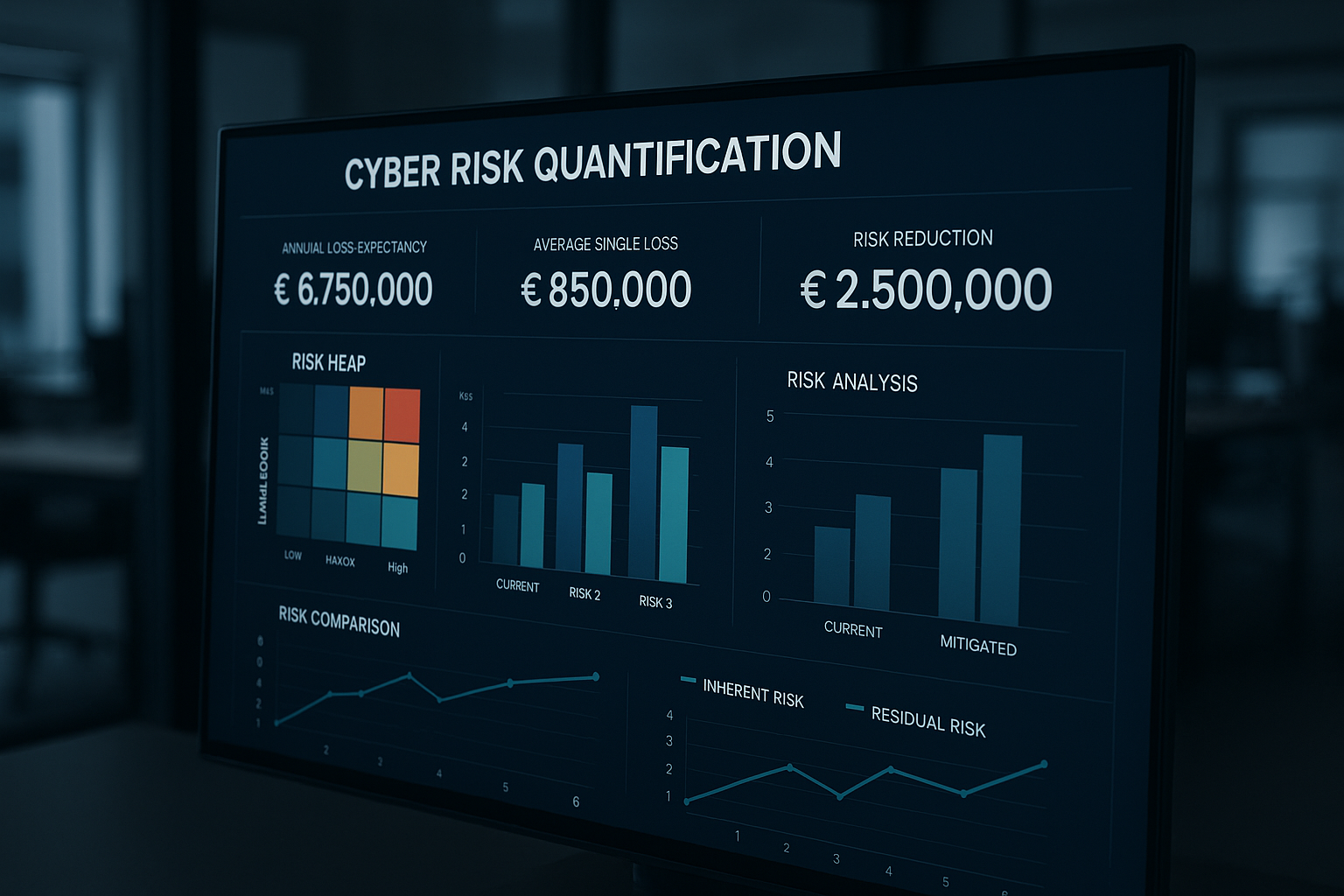
Compare CRQ tools from SecurityScorecard ($16.5K/yr) to enterprise platforms ($50K+) and discover why SMBs need a middle ground — financial-exposure estimates starting at €9.
Cyber Risk Quantification Tools 2026: The $50K Gap Between Free and Enterprise
There’s a dangerous gap in the cyber risk quantification (CRQ) market. On one side, you have free A-F scorecards (like SecurityScorecard’s self-monitoring tier) that give you a letter grade but no financial context. On the other, enterprise CRQ platforms like Safe Security, Kovrr, and Axio that start at $50,000+ per year.
SMBs and mid-market firms fall through this gap. They’re stuck with letter grades they can’t act on, while attackers weaponize CVEs within hours of disclosure.
The CRQ Market: $2.8B and Growing
The cyber risk quantification market was valued at $2.8 billion in 2025 and is projected to reach $9.6 billion by 2034 — a compound annual growth rate of 12%. The attack surface management segment is growing even faster at 21% CAGR, reaching $5 billion by 2034.
Despite this growth, the actual tools available to SMBs haven’t evolved. You either get:
- Free rating tools — SecurityScorecard, UpGuard, Bitsight scorecards
- Enterprise CRQ suites — Safe Security, Kovrr, Axio, RiskLens
The Pricing Landscape
| Tool | Starting Price | CRQ Included? | SMB Accessible? |
|---|---|---|---|
| SecurityScorecard Self-Monitor | Free (Forever) | No — add-on | Yes (limited) |
| SecurityScorecard TITAN Watch | ~$16,500/yr | Add-on (+$?) | Unlikely |
| UpGuard Standard | $21,000/yr | Basic scoring | Unlikely |
| UpGuard Professional | Custom (high) | Yes | No |
| Bitsight | Custom (enterprise) | Yes | No |
| Safe Security | $50K+/yr | Yes (FAIR-derived) | No |
| Kovrr | Custom (enterprise) | Yes (FAIR+Monte Carlo) | Insurance only |
| Axio | Custom (enterprise) | Yes (Cyber Stress Test) | No |
| Resiliently | **€9/scan | €29/mo Pro** | Yes (€-denominated) |
Why Security Ratings Are Failing CISOs
CISO sentiment against the major rating agencies has reached a boiling point in 2026:
“SecurityScorecard grades are a charade. They don’t tell me what my actual breach exposure costs.” — CISO survey, Q1 2026
“Predatory pricing and opaque scoring. I spend more time defending my score than improving security.” — Anonymous CISO, Reddit r/ciso
The core problem is that A-F letter grades don’t translate to budget decisions. A “B” grade doesn’t tell a CFO: “This exposes us to €50K in potential breach costs.”
The Enterprise CRQ Trap
Enterprise CRQ tools solve this — they produce financial loss distributions (50th, 75th, 95th percentiles) using FAIR methodology + Monte Carlo simulation. But they require:
- Dedicated risk analysts
- Months of implementation
- Six-figure annual contracts
A mid-market insurance broker with 5-50 clients can’t justify $50K/year for a CRQ platform. But they can buy 10 scans at €9 each.
Why Financial-Exposure Estimates Win
The key insight from Hubbard Decision Research’s “How to Measure Anything in Cybersecurity Risk”: point estimates produce false precision. A single “ALE = $300K” number treats uncertainty as certainty.
The modern standard — FAIR decomposition + Monte Carlo simulation — produces probability distributions that capture both expected loss AND tail risk. This is what insurance underwriters actually use to make decisions.
Resiliently’s approach:
- Domain exposure scan — continuous monitoring of internet-facing assets
- Financial exposure estimate — €-denominated, based on industry, revenue, and asset type
- PDF export — broker-ready submission document
- €29/mo unlimited — less than the cost of a single SecurityScorecard vendor assessment
The Bottom Line
The $50K gap between free rating tools and enterprise CRQ suites represents the single biggest opportunity in the cyber risk market. SMBs and insurance brokers don’t need another letter grade. They need to answer one question:
“If breached, what does this cost us in euros?”
Resiliently answers that question starting at €9.
Try the Domain Exposure Checker — get your financial risk estimate in 60 seconds.
Related: Why Brokers Need Better Cyber Tools in 2026
Get the full picture with premium access
In-depth reports, assessment tools, and weekly risk intelligence for cyber professionals.
Best Value
Pro Membership
€49 €19 /month
Founding member price — lock it in forever
Unlimited reports + tools + alerts
Subscribe Now → 30-day money-back
Secure via Stripe
Cancel anytime
Free NIS2 Compliance Checklist
Get the free 15-point PDF checklist + NIS2 compliance tips in your inbox.
Check your inbox! Your checklist download is on its way.
Something went wrong. Please try again.
No spam. Unsubscribe anytime. Privacy Policy
blog.featured
The Resilience Stack™: A Five-Layer Framework for Cyber Insurance Risk Assessment
Resilience Stack ·
12 min read
The Cyber Insurance Submission Crisis: 7 Reasons Brokers Can't Afford Manual Risk Assessments in 2026
Cyber Insurance ·
6 min read
Cyber Risk Quantification Tools 2026: The $50K Gap Between Free and Enterprise
Cyber Risk Quantification ·
4 min read
NIS2 Compliance Is Now an Underwriting Requirement — Every Broker's Duty of Care
NIS 2 ·
4 min read
Premium Report
2026 Cyber Risk Landscape Report
24 pages of threat analysis, claims data, and underwriting implications for European cyber insurance.
View Reports →Verwandte Artikel

Attack Surface Management · · 6 min read
Attackers Don't Wait 24 Hours: Why Daily ASM Scans Leave You Exposed
Unit 42 research shows attackers scan for new CVEs within 15 minutes of disclosure. SecurityScorecard and UpGuard scan daily. Resiliently scans hourly. Here's why the gap matters for your cyber insurance renewal — and how hourly scanning with euro-denominated risk quantification changes the underwriting conversation.
Cyber Risk Quantification · · 4 min read
Cyber Risk Quantification Tools 2026: The $50K Gap Between Free and Enterprise
Compare CRQ tools from SecurityScorecard ($16.5K/yr) to enterprise platforms ($50K+) and discover why SMBs need a middle ground — financial-exposure estimates starting at €9.

Security Ratings · · 5 min read
Why Security Ratings Don't Work for Cyber Insurance Underwriting (And What Does)
BitSight, SecurityScorecard, and UpGuard give you an A-F score. But underwriters need financial exposure in EUR. Here's why passive security ratings fail underwriting decisions and what Resiliently's financial exposure approach does differently.